The valley blizzard
Butcher's CrossingThe valley blizzard is the crisis that traps Miller’s hunting party in the mountains after its mass slaughter of American bison. It strips away the party’s means of transport, scatters some of its hard-won hides, and reduces travel through a vast landscape to a struggle for warmth and orientation. For William Andrews, the storm also reverses the valley’s earlier promise: a place that had seemed to offer boundless space becomes a white enclosure in which familiar bearings, remembered places, and even the way back to camp can disappear.
Causes and Conditions
The blizzard arrives against a history of mounting pressure on the expedition. Miller recalls that Kansas once held immense herds, but that hunters had reduced them to smaller groups and that little might remain to hunt in another year or two. The change is visible not only in the shrinking herds but in the landscape of their remains: Miller recalls riding among mountains of bison bones from Pawnee Fork to the end of Smoky Hill, and warns that even these remains may soon be taken away for fertilizer. In Bison Valley, the same pattern has become a daily labor: the herd thins among carcasses, and William Andrews understands that Miller will not leave while a single bison remains alive.
The party’s vulnerability is practical as well as psychological. Earlier on the expedition, the oxen crowded against the wagon’s rear board, where the remaining water was stored, and Miller carefully gathered what was left in the canteens into a small wooden keg. The water shortage belongs to the wider journey rather than the snowfall itself, but it establishes how little margin the party has when conditions turn against it. The blizzard makes that narrow margin decisive: the wagon becomes an obstacle, the hides become emergency shelter, and the route out of the valley ceases to be usable.
The Storm Breaks
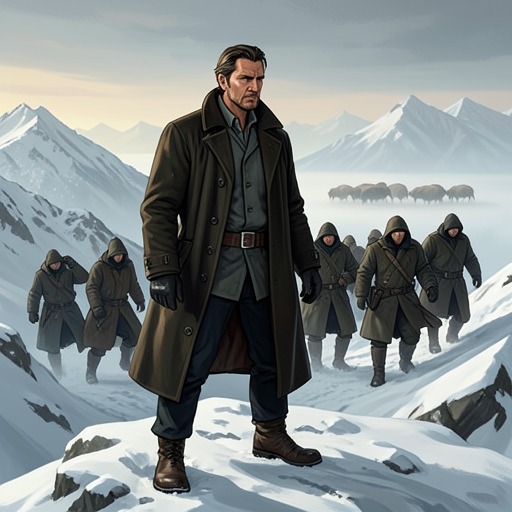
The first snowflakes fall while the men are out in the mountains. Fred Schneider points into the air, and William Andrews initially treats the snowfall lightly; Miller and Schneider, however, are already watching the darkening sky. Miller cuts the moment short and turns the party back toward camp before the weather worsens. Soon the wind drives snow across the mountains in stinging bursts, forcing the men to bend against it. Andrews loses feeling in his hands and repeatedly beats them against his legs to bring back sensation. The snow gathers between his knees on the saddle, while the party’s companions and wagon are difficult to make out through the blowing whiteness.
Miller decides that the wagon is slowing them down and orders William Andrews to keep hold of the horses while he and Fred Schneider free the oxen. The separation proves dangerous almost at once. Andrews struggles to manage the horses as wind and snow erase the tracks, and he can no longer see the wagon, the oxen, or the men behind him. He follows the faint groove of his own passage until it vanishes, then stumbles and crawls through the snow rather than release the reins. When he hears a distant cry, he runs toward it; Miller emerges from the storm and takes the horses, prying Andrews’s cramped fingers from the leather.
The group finds its way toward the familiar trees and the large rock where it had made its fire. The men lead the horses into Charley Hoge’s wooden enclosure and secure them together, taking care to keep the stirrups from striking their sides in the wind. When they reach the piled hides, they discover that the storm has already carried away much of one unbundled stack. The remaining skins lie overturned or flap in the gale, with only a few corners of the smaller pile showing through the snow. The scene makes the hunt’s material reward suddenly precarious: hides accumulated through relentless labor are now exposed to a force that scatters them without regard to their value.
Shelter and Separation
Miller responds by turning the hides into shelter. As Fred Schneider cuts the frozen straps, the wind snatches away about a dozen skins. Miller calls for each man to take several, then works on the snow with a knife and pieces of strapping. He pairs hides fur-to-fur, ties their legs together, and uses two more skins to form an improvised cover with its ends open. The resulting hide sack can shelter two people from the wind and snow. Miller drags it toward a drift and presses one opening against the growing bank so that the snow itself helps close the shelter.
The storm also sharpens the conflict between Miller and Schneider. Miller tries to stop the men from exhausting themselves in the cold and tells Schneider to free more skins. Schneider, convinced that his own plan is better, insists on working separately. Miller finally gives him the remaining straps and leaves with William Andrews, who looks back to see Schneider tying his hides together alone and angrily, still exposed to the blizzard. Miller and Andrews place their shelter beside the one enclosing Charley Hoge, then Miller instructs Andrews to crawl in, lie still, and conserve his strength. The hides that had held the bison’s flesh only days before now form a rough barrier between the men and the weather.
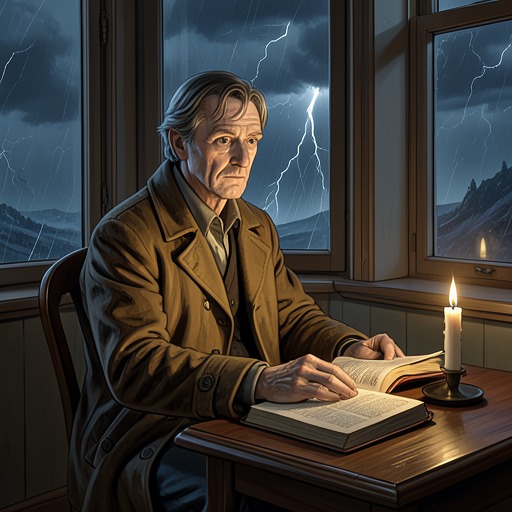
For two days and three nights, the blizzard roars across the plateau. The men remain beneath the snow, emerging occasionally for relief or to dig openings that let air into their dark hide shelters. Andrews sleeps for much of the time, and when awake curls onto his side with his knees drawn toward his chest. His thoughts slow and blur with his body’s effort to stay warm. He remembers the comfort of his home in Boston—a feather bed, a sheltered parlor, quiet conversation—but those recollections feel remote and nearly unreal. The storm does not merely interrupt the expedition’s movement; it makes the world beyond the shelter difficult for him to hold in mind.
Entrapment and Significance
When the weather allows Miller to ride toward the pass, he is gone for nearly two hours. He returns exhausted, his hands darkened by cold and powder, and reports that the party is blocked by snow. He had to turn back half a mile from the pass, where the drifts were about twelve feet deep and appeared deeper farther on. Schneider answers with anger because he had urged the party to leave earlier. Miller’s response is not to dispute the warning or promise a quick escape: he proposes that they prepare to withstand another storm and wait. Schneider says he will return home if he can find a way; Miller does not prevent him, but the exchange confirms that the party has no immediate route out.
The blizzard’s force is heightened by the contrast with the landscape William Andrews had encountered on the approach. At the river beneath the mountains, the dense pine forest had seemed to him like a frozen sea without measure or identity. From the entrance to the valley, the broad, quiet grassland had appeared almost untouched by human presence. Under the storm, however, grandeur offers no protection. The mountains vanish from sight, the snow erases the trail, and Miller himself rides with his eyes closed against the wind, guiding the others by a direction he can no longer see. The party’s dependence on his judgment persists even when the landscape has defeated ordinary sight.
The episode also distinguishes the blizzard’s loss from the later destruction of the expedition’s cargo. The storm carries away some hides and buries the men, but the surviving party eventually leaves the valley; during the later spring river crossing, the wagon overturns and the remaining bison hides are swept away. The blizzard is therefore not the final loss of the expedition’s material return, but it is the ordeal that first makes the men’s control over their route and their gains visibly fragile. Its whiteout stands against the party’s earlier confidence in hunting, loading, and traveling according to plan: in the valley, survival depends on improvised shelter, patience, and the hope that the pass will open.